One of Ida's skills
Deep Reckoning
A skill for producing different perspectives and paths forward on a question Ida has danced around for months. Over many sessions, the skill turns that question into a page of paths she can weigh and act from, with one named recommendation.
Most of this page, and the skill it documents, was written by AI, specifically Claude Opus 4.8 and 5. Deep Reckoning is a skill Ida's AI wrote and revises from her feedback; the same AI compiled this page from the skill's files, and Ida edited it. The essay it belongs to, Obsessing Over AI Agents Is Slowing You Down, is entirely her writing.
The Skill Files
The largest skill of the four: one instruction file and seven reference files. A run of this skill is called a reckoning; three real ones have been completed, and their material is woven through every file below, holding too much private information to share. So unlike the other three skills, none of these files are shown or downloadable. The descriptions below say what each one holds.
▶
deep-reckoning/
The eight files, each described.
▶SKILL.mddescription only
The instructions: the pipeline, the five passes, and how a run pauses and resumes across sessions.
This file is woven through with material from the real reckonings, so it stays described rather than shown.
▶cycle-procedures.mddescription only
The procedure each pass follows, with its acceptance checks.
This file is woven through with material from the real reckonings, so it stays described rather than shown.
▶gates.mddescription only
The twelve rules in full, called gates: each with the documented failure it prevents, where it is enforced, and the check that decides pass or fail.
This file is woven through with material from the real reckonings, so it stays described rather than shown.
▶scope-probe-method.mddescription only
The Scope dialogue: the list of shapes a hidden question tends to wear, the construction rules for candidate framings, and example dialogues showing how the questioning works.
This file is woven through with material from the real reckonings, so it stays described rather than shown.
▶staging-and-recon.mddescription only
The staging procedure: the two kinds of evidence (Ida's own records and outside research), the source-file discipline, and the rules for citing research honestly.
This file is woven through with material from the real reckonings, so it stays described rather than shown.
▶render-phase.mddescription only
The Render procedure: the design consultation, the clarity checks, and the hard acceptance rules a finished page must pass.
This file is woven through with material from the real reckonings, so it stays described rather than shown.
▶writing-standard.mddescription only
The prose standard for everything the skill writes, including its naming rules.
This file is woven through with material from the real reckonings, so it stays described rather than shown.
▶reckoning-log-template.mddescription only
The schema for the single state file: the ledgers, the table of where each pass stands, the section for questions still waiting on Ida.
This file is woven through with material from the real reckonings, so it stays described rather than shown.
What It Is
Some questions don't fit in a work session. They have sat unresolved for months, tangled up with other decisions, and part of what keeps them unresolved is fear of what the answer might be. This skill deals with that. Think of it as a method to answer a question that has a ditch under it you're freaked out about falling into.
The real questions the skill was built on (the skill calls the fully scoped version the founding question) are too personal to publish, which is true of most questions this skill exists for. So here is an invented one: a creative director's reckoning question written the way the skill's first pass would cast it after a dialogue to get to the root of the issue:
A question like that can have unhelpful answers in two opposite directions, and the skill is built against both. It can be whitewashed: false reassurance, "your standards haven't slipped" when the honest answer is harder. Or it can deliver the false verdict: the reductive answer the person fears, delivered with false confidence. The skill names both failure directions out loud at the start of every reckoning, and the output has to hold a genuine range of options and one concrete recommendation that answers the question. A second rule (Gate 1, below) keeps the answer honest: confidence sets how firmly a conclusion is stated. A hard answer the reckoning is only 60% sure of still gets stated, at 60%.
- held open for months and high-stakes
- nebulous and entangled with other decisions
- frozen partly by fear of the answer
- rich in real evidence: career and identity, practice and business, financial structure, creative legacy
- a merely stalled project (the skill refuses to run on one)
- everyday decisions
- prioritizing what to do next
- purely emotional or relational questions, which are held out as a known future variant
A full reckoning runs across six or more fresh sessions (each a separate conversation with the AI), and the skill says so before anything starts, so a casual invocation can downshift to a lighter conversation that stops earlier.
What It Needs to Run
- Claude Code on a Mac, and more patience than any other skill in the set: a full run spans weeks of sessions.
- Ida's own record. The evidence is mostly hers: past work, feedback, financials, history, assembled into named source files. What exists only in her head, she dictates into a file before the reasoning needs it.
- A state file on disk. A process spanning many sessions can't keep its memory in any one session. A single log file holds where things stand, what's been decided, and what's still open; every session reads it first and writes back to it, so an interrupted session loses nothing.
How It Runs
A reckoning is built in passes, each producing a piece the next one builds on.
Why Scope is a conversation. The question Ida arrives with is usually a stand-in for the real one. The reckoning that taught this began as a small copy-revision project that turned out to be quietly carrying a much bigger question. So Scope offers her two or three candidate framings at different sizes to react to, because she recognizes and edits a stated framing far more reliably than she generates one from nothing. Get the question wrong and everything after is aimed at the wrong target.
Why every pass gets a fresh session. Each pass is drafted in the main conversation, then stress-tested by a fresh session that has never seen the work, then executed by another fresh session working only from the brief. A session grading its own work misses what an independent one catches, a failure documented in the reckoning this skill was built from.
The Gates
The skill holds twelve standing rules that every pass must follow. The skill's files call them gates because each comes with a check, and work that fails the check does not move forward. They are not passes; they apply during every pass. Two guard against the two failure directions, whitewash and the false verdict. The other ten are working rules for the reasoning itself:
| Gate | What it holds |
|---|---|
| 1 · Confidence sets tone, never silence | Every conclusion appears at its true confidence; a high bar sets tone only, never suppresses the hard answer |
| 2 · The two fears | The skill names whitewash and the false verdict at the start; the output carries a range and a named recommendation |
| 3 · Ground or flag | A path is instructive only with a real example or a documented past episode; naming who to call is a complete answer, not a failure |
| 4 · Symmetric search | Look for disconfirming cases, not just confirming ones; state what usually happens in cases like this before arguing this case is different |
| 5 · Evidence calibration | Tag each claim by what could settle it: records, a real-world test, or only living it; every confidence carries its derivation |
| 6 · Hold tensions | Named tensions stay open; a verdict that depends on one is rendered conditionally, with what would settle it |
| 7 · Cross-pass contradiction | A later pass reports where its findings move an earlier read rather than silently deferring to it |
| 8 · Desire weighed, never ruling | Stated desire is weighed alongside the calibrated read, marked once, never promoted above it |
| 9 · Preserve the position | A decision that is Ida's renders as hers to make, marked "your call," never a filled-in default |
| 10 · Name what's beyond reach | Blind spots are flagged up front; every named exemplar carries its verification tag |
| 11 · One-glance top layer | The page opens with the founding question, then the answer, then the recommendation, above the detail |
| 12 · Structure and naming | A set of distinctions is a framework only if moving a case across its parts changes a decision; a name must mean one specific thing |
The gates exist for a specific reason. The process was worked out on a stronger, slower model that held these rules by judgment. Day to day the skill runs on the faster everyday model, which fails in exactly the opposite ways: quick verdicts on thin evidence, more confidence than the evidence supports, drama where calibration should be. The gates put the rules into the structure, so following them doesn't depend on trusting the model. Whether that works is still being tested; in the first two reckonings, it did.
The Output
The output is a designed page rather than a report, because Ida reasons over structure she can see far better than she organizes from a blank field. The page opens with the founding question verbatim, then a one-line answer, then the recommendation: the whole reckoning at one glance, detail underneath.
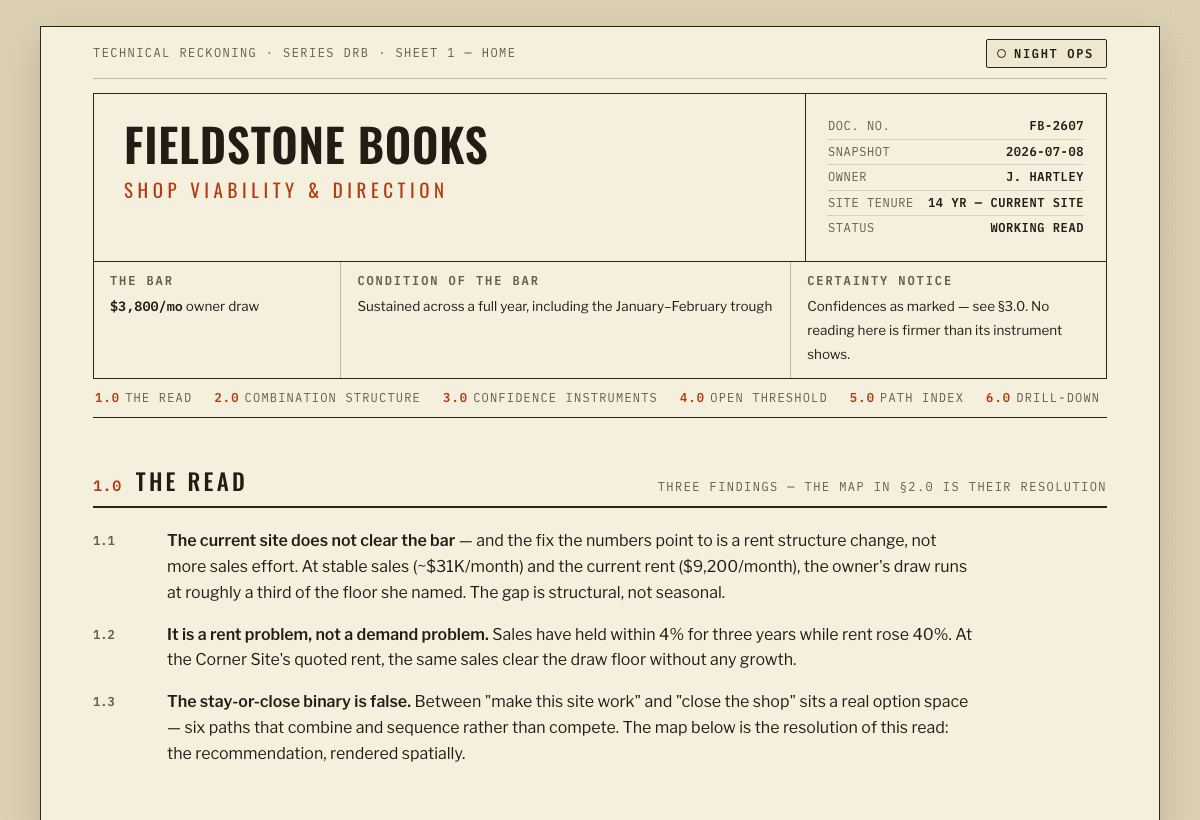
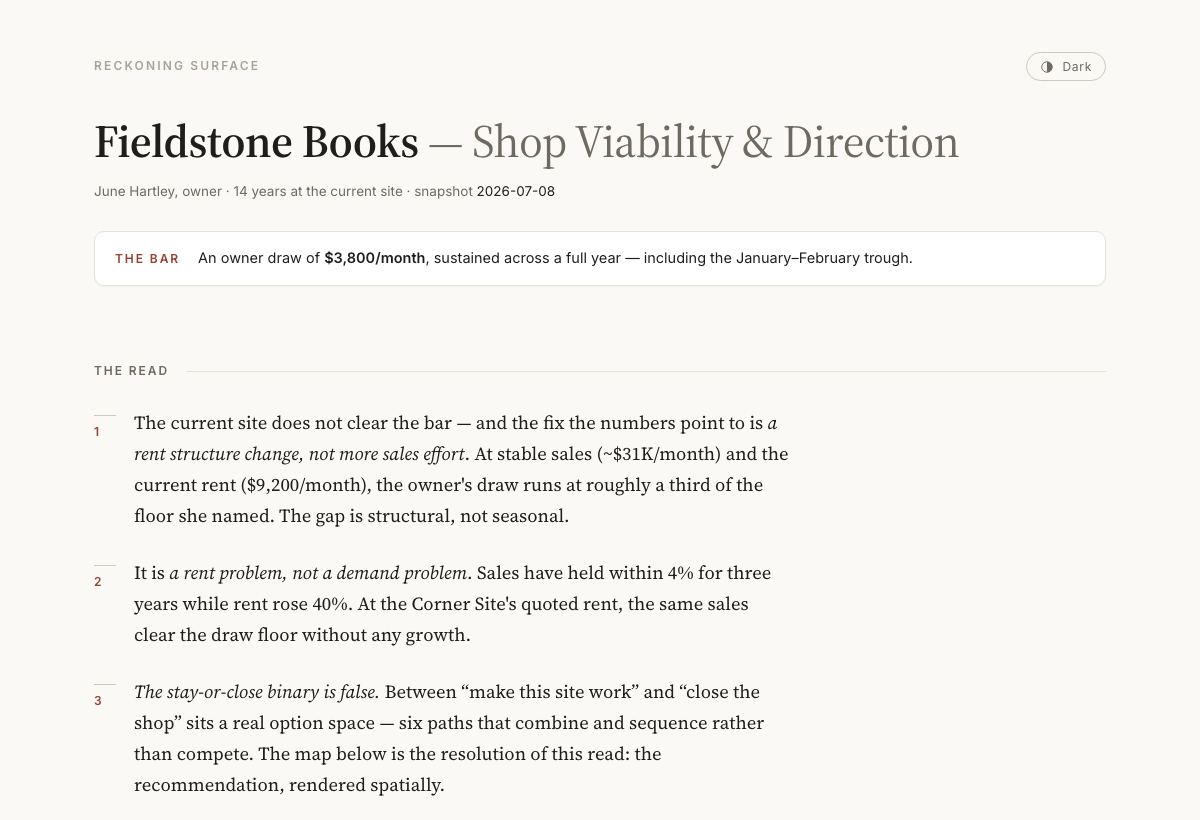
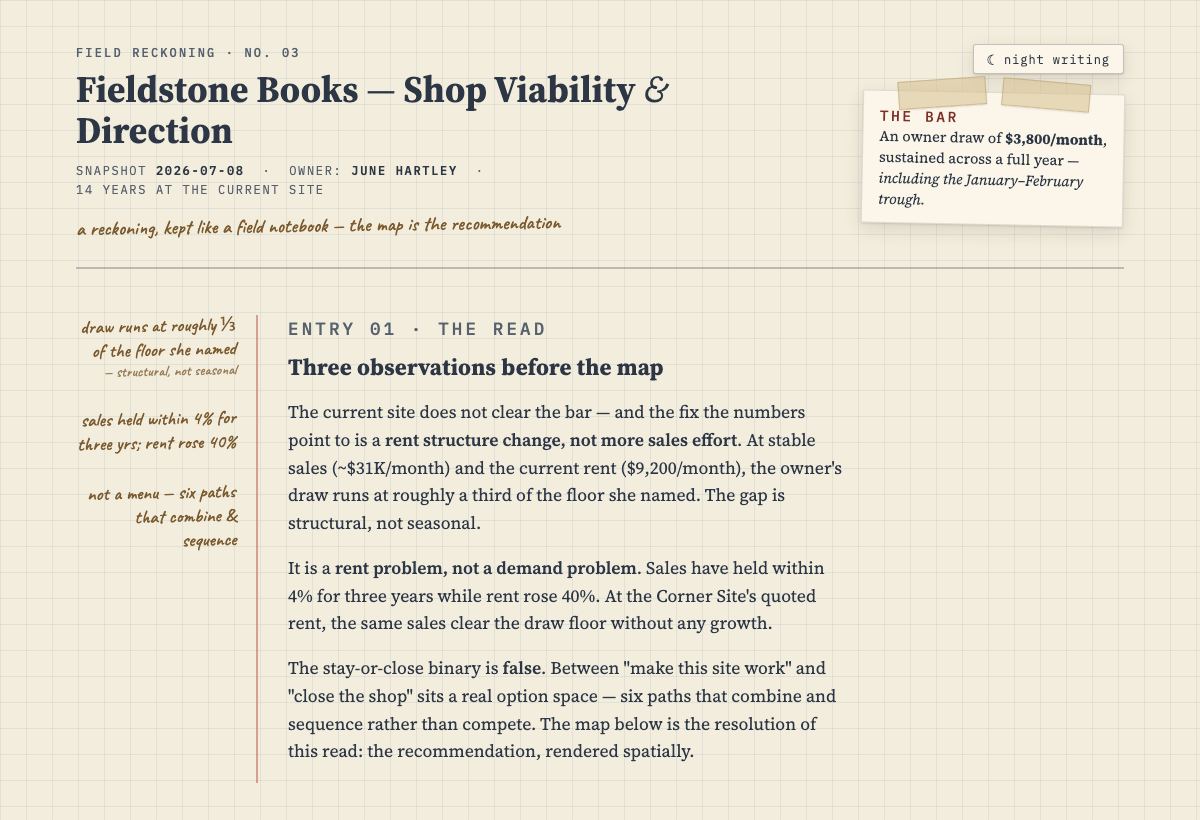
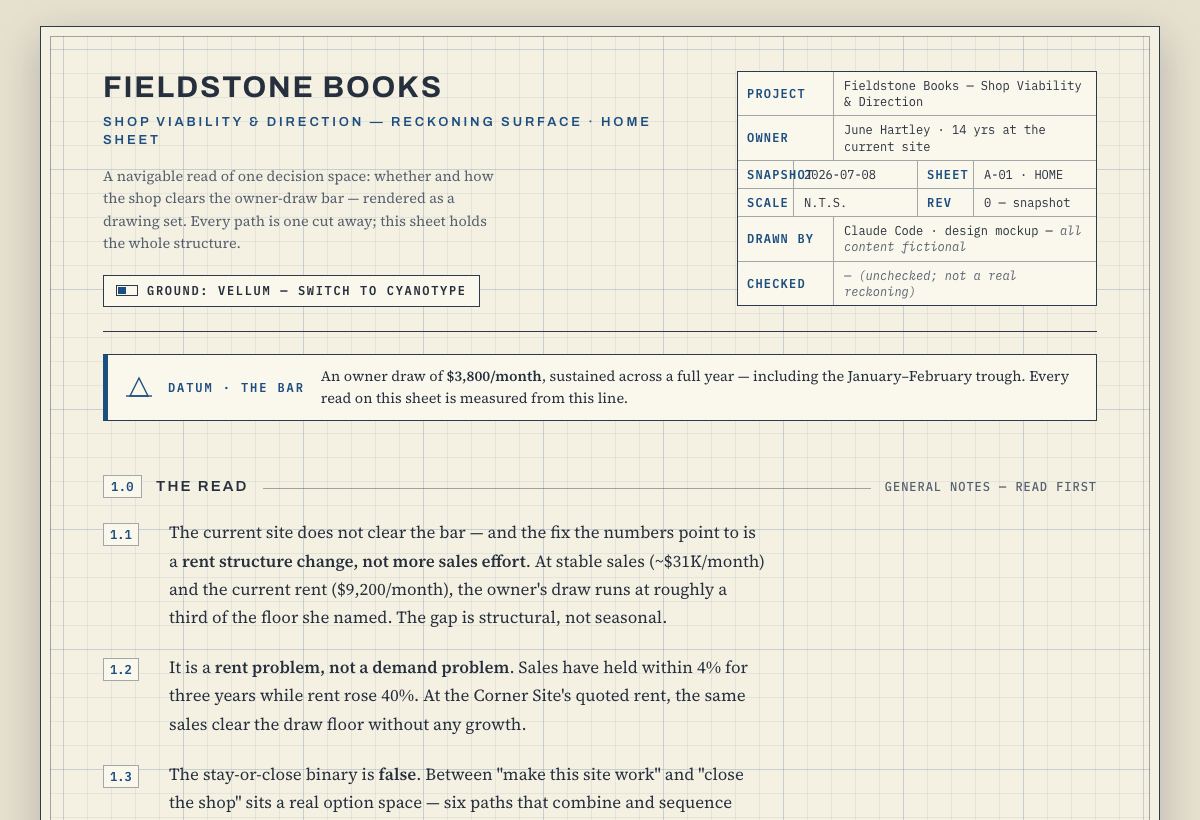
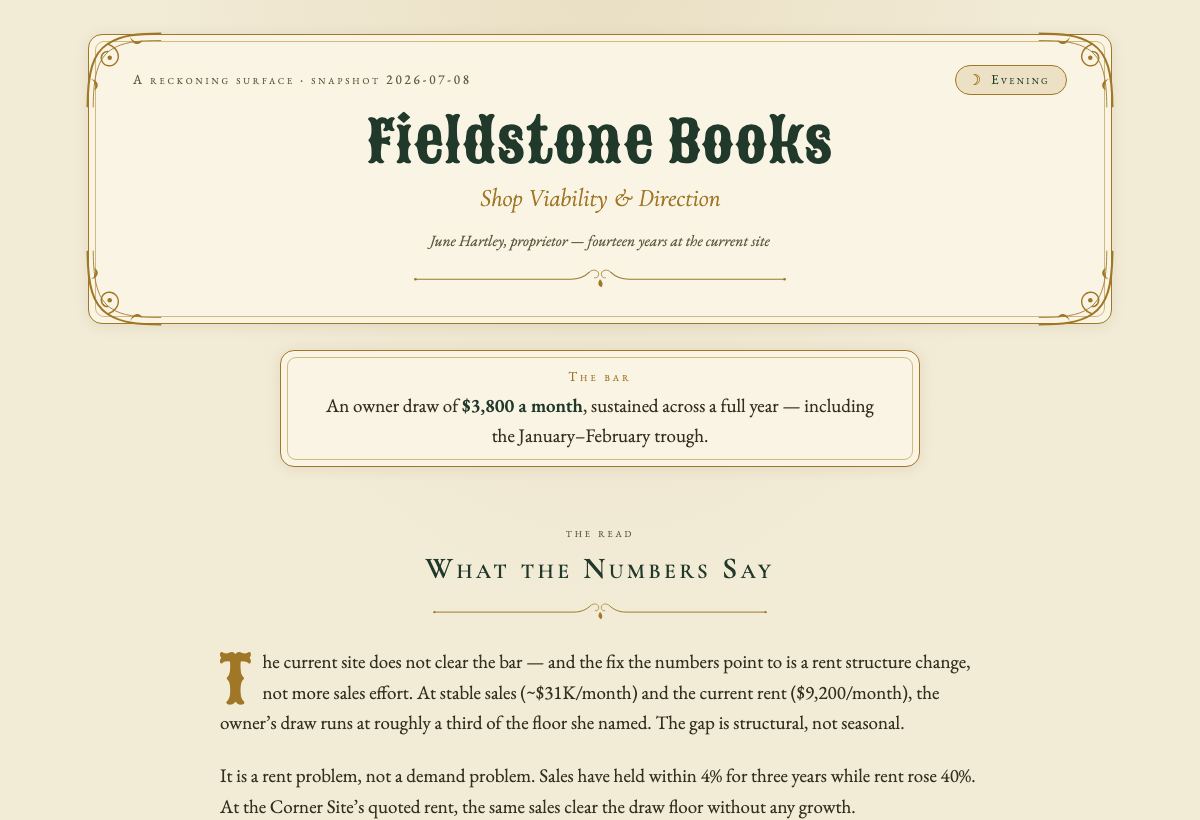
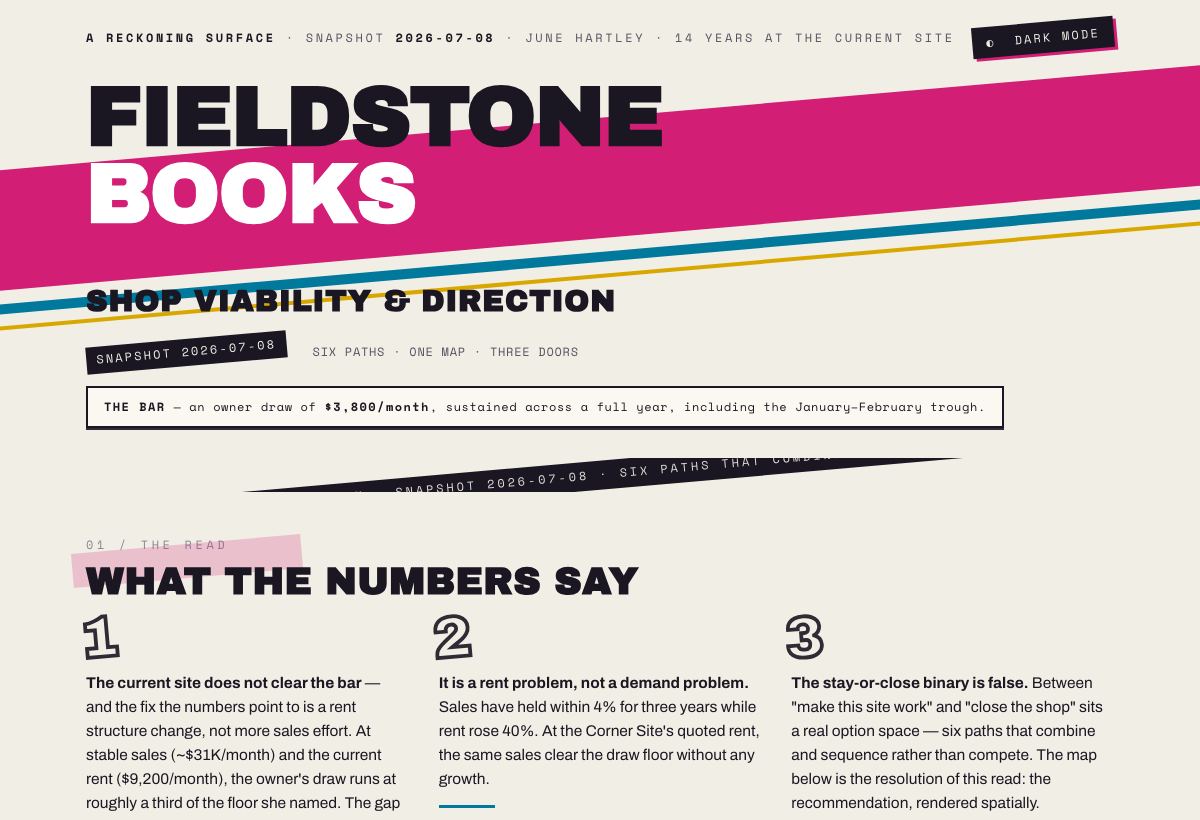
Building that page doesn't start from a blank slate either. The skill keeps six fully built design directions (from a calm retro technical manual to art nouveau, each suited to a different kind of question), all rendering the same invented case, a fictional bookshop weighing its options, so they compare fairly. Ida reacts to real pages in a browser, and the winning design is rebuilt carrying the real reckoning's content. All six are below, each linking to its full mockup.
The page ships with a companion file, the conditions ledger: a plain table with one row for each go/no-go signal the reckoning named, giving the condition, what would count as evidence of it, and empty columns for the date, the event and the result. It is a simple text file rather than part of the page, so Ida can add a row from her phone when something happens, and the recommendation links to it. Results for the signals the reckoning named can still be recorded long after the reckoning is finished.
Changes So Far
Ida ran one reckoning by hand before the skill existed. The result held up: she kept returning to the output for weeks, guiding her actions by its recommendations, and it showed her approaches fitted to her priorities and context that she hadn't considered. So the process that produced it was written down as a repeatable skill, with the gates added, built from a real run rather than designed in the abstract.
The next reckoning was the first to run under the written version, and it doubled as the skill's validation: it surfaced fifteen refinements that folded back into the files.
A third reckoning ran under the written version. Its finished page displayed garbled punctuation when Ida opened it on her phone, because the file left out two lines that tell the phone how to decode the characters and fit the page to a small screen. Every finished page now has to include them and gets rendered at phone width before it ships.
Ida asked the skill to take on a question she had been circling. The fit check found a bounded decision held up by fatigue and an unresponsive outside party, with no deeper question underneath, and the skill declined. The project went on hold instead.
The first two finished pages named conditions to watch for, but left nowhere to record what happened. Render now produces the conditions ledger described above, and Ida's weekly review asks whether anything belongs in it.